Course Progress Journal
A reflection on core HCI concepts as discussed in Dix et al.
Week 1: Human Memory & Foundations
We explored the limitations and techniques of human memory as mentioned in Dix et al. (Ch. 1).
- Memory Techniques: Association of events and stories improves retention (p. 39).
- Memory Flow: Information moves from Short-Term Memory (STM) to Long-Term Memory (LTM) via rehearsal.
- HCI Definition: The intersection of Psychology, Design, and Computer Science.
- Key Figure: John M. Carroll, the father of HCI.
Miller's Law: The average person can store 7 ± 2 chunks of information in their STM.
Summary of Week 2
- UI and Logo Design: Exercises in creating the user interface and logos for common, well-known applications.
- The Pyramid of Roles: A discussion on the hierarchy between Thinkers (at the top of the pyramid) and Developers (at the bottom).
- Student Presentations: Peer review and presentation of Week 1 topics by students.
- Human Process Model: Introduction to the Semantic Net by Card, Newell, and Moran, which provides an analogy between how computers and humans process information.
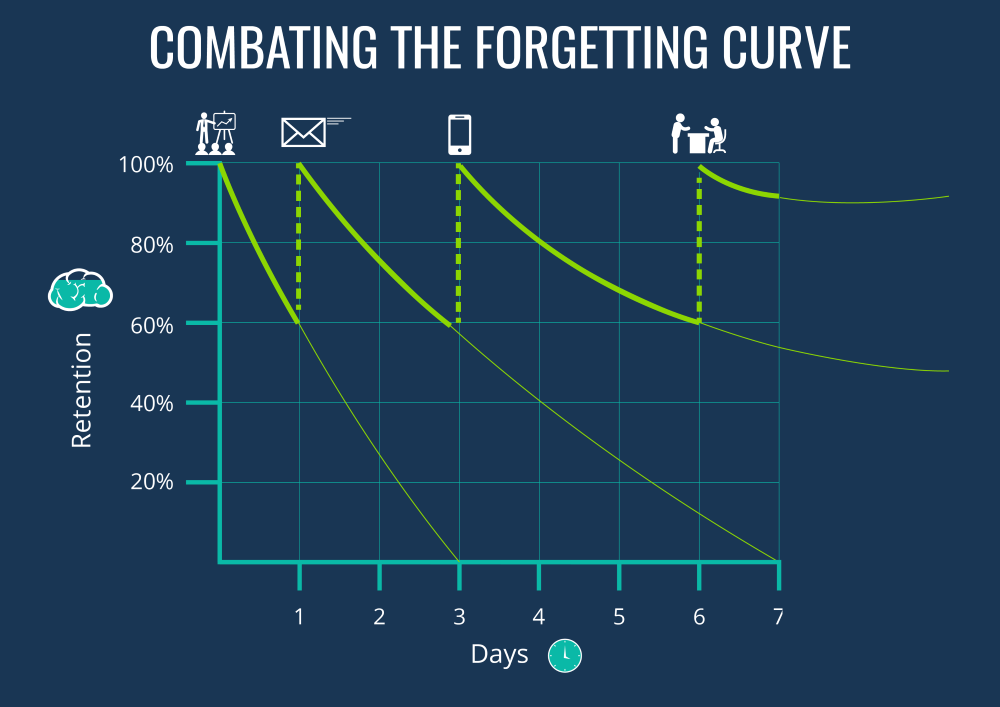
- Memory Retention: Studying The Forgetting Curve and understanding how active rehearsal decreases the rate of forgetting.
- Image Formats: Identifying the differences between Vector and Raster graphics.
- The Automatic Syringe Dose Calculator: A case study where the design shifted from a standard calculator interface to an increment/decrement counter based on user surveys, highlighting that design is highly dependent on the target user.
The Seven Stages of Norman’s Model
The cognitive steps a user takes when interacting with a system:
- Goal: What the user wants to achieve.
- Intention: The internal decision to act.
- Specification: Defining the specific actions needed.
- Execution: Performing the physical action.
- Perception: Seeing the state of the world/device.
- Interpretation: Understanding what was perceived.
- Evaluation: Checking if the goal was reached.
Week 3: Quiz
The Quiz helped with the revision of previous weeks' concepts, and the three questions on Norman’s Seven Stages were particularly insightful.
The Seven Stages:
- Goal (Forming the objective)
- Intention (The decision to act)
- Specification (Selecting specific actions)
- Execution (Physical performance)
- Perception (Observing the state of the world)
- Interpretation (Understanding the observation)
- Evaluation (Comparing result with the goal)
Applied Scenarios:
- Toggle Switch:
- Who Paid Problem:
- Automatic Syringe Dose Problem:
Week 4: Shneiderman’s Rules & GOMS
A transition into formal interface guidelines and the GOMS predictive model.
Shneiderman’s 8 Golden Rules (p. 283):
- Strive for Consistency
- Enable Frequent Users to use shortcuts
- Offer Informative Feedback
- Design dialogues to yield closure
- Offer Easy error handling
- Permit easy reversal of Action
- Promote internal locus of control i.e user should feel in control
- Reduce Memory load
GOMS vs. Norman:
GOMS: Goals, Operators, Methods, Selection Rules. Unlike Norman, GOMS does not model Specify, Perceive, Interpret, or Evaluate.